The Lehi Silver Band & Its Famous Bandwagon

The Music That Became the Soundtrack of a Community
Long before loudspeakers, radios, and recorded music filled the air, the sound of a brass band was the heartbeat of a celebration. In Lehi, no Fourth of July parade, community gathering, political rally, or holiday festival felt complete without the stirring music of the Lehi Silver Band. For generations, the band's lively marches echoed down Main Street, bringing neighbors together and creating memories that have lasted for well over a century. Few organizations have become as deeply woven into Lehi's identity as the Lehi Silver Band and its one-of-a-kind bandwagon.
The story began in March 1887, when a group of young men organized the YMMIA Silver Band under the direction of Joseph Kirkham. While the band was sponsored by the Young Men's Mutual Improvement Association, its name reflected one of the biggest political debates of the day. Across America, people argued whether the nation's currency should be backed by gold alone or by both gold and silver—a movement known as bimetallism. Proudly embracing the cause, the musicians called themselves the Silver Band. But politics soon took a back seat to music, and before long the band became known simply as the Lehi Silver Band, entertaining audiences throughout Utah County.
The Birth of a Legendary Bandwagon
As the band's popularity grew, members dreamed of something that no other community possessed—a rolling stage where musicians could perform while traveling through parades. That dream became reality in the spring of 1891.
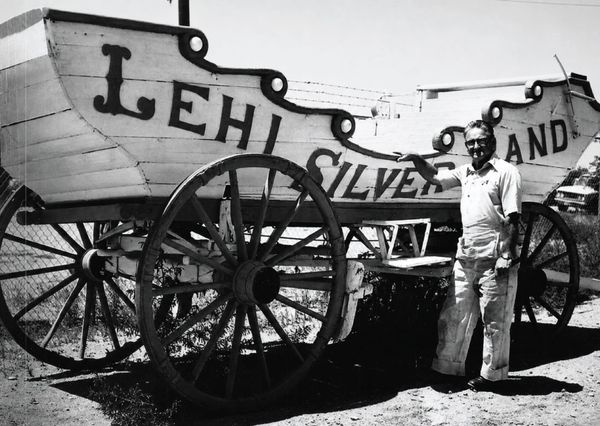
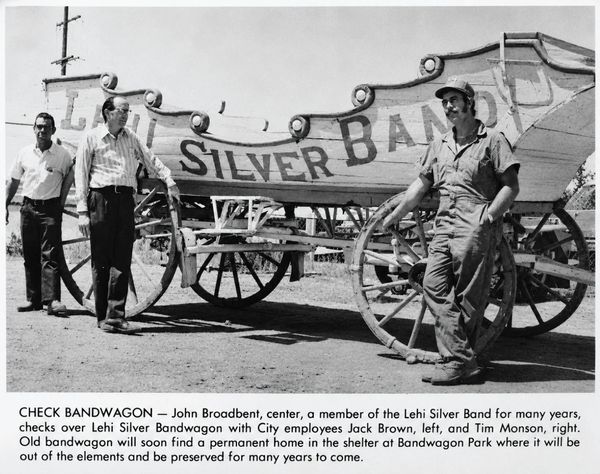
While attending the Mitchell Fair in Salt Lake City, band financial director William Goates admired the beautifully crafted running gear displayed by the Cooperative Wagon & Machine Company. He immediately envisioned it carrying Lehi's musicians through parades. The band purchased the wagon, and master craftsman Gay Whipple built an elaborate custom wagon box unlike anything people had seen before. Rather than looking like an ordinary farm wagon, Whipple designed it with graceful, ship-like curves, decorative scrolls, and built-in seating for the musicians. Finished with a polished "piano finish," it quickly became one of Lehi's greatest sources of civic pride.
Then came the artwork.
In 1895, after returning from studying art in Europe, talented Lehi artist Edwin Evans was hired to decorate the wagon. His elaborate paintings transformed it into a traveling masterpiece. The most talked-about feature was a pair of beautifully painted mermaids adorning each side of the wagon. While many admired Evans' artistry, local legend says some members of the Relief Society thought the bare-shouldered mermaids were a bit too daring for a church community! Whether admired or criticized, everyone agreed the wagon was unforgettable.
Rolling Through History
Whenever the Lehi Silver Band appeared, crowds gathered.
The musicians rode through town in distinctive uniforms while playing patriotic marches, popular tunes, and festive music. Early uniforms included white linen dusters and summer helmets, later replaced by green uniforms with black trim, and eventually gray suits and caps. The wagon itself became as recognizable as the musicians riding inside it. Children waved from the sidewalks, families lined parade routes, and visitors remembered Lehi as "the town with the beautiful bandwagon."
Like many community organizations, the band experienced periods of great success and times when membership dwindled. During the 1920s and 1930s the organization nearly disappeared, and the treasured wagon spent decades sitting outdoors, slowly weathering Utah's harsh seasons. At one point it narrowly escaped destruction in a barn fire—a close call that could have erased one of Lehi's most cherished historic artifacts forever.
A Second Life
The story didn't end there.
In 1952, local musician Donald Wright revived both the band and the famous wagon. The wagon received a fresh coat of Lehi High School purple and white paint, replacing the earlier artwork, and once again carried musicians through parades across Utah. For another generation, the familiar sound of brass instruments rolling down Main Street became part of Lehi's traditions.
By the mid-1970s, however, time had taken its toll. The wagon's wooden wheels had become so fragile that city crews reportedly removed them before parades and soaked them in Dry Creek to keep the wood from cracking. Realizing the original wagon deserved preservation rather than continued use, Lehi retired it after its appearance in the 1976 Days of '47 Parade. During a special ceremony, the wagon was placed in its permanent home at Bandwagon Park, where it could be protected and appreciated by future generations.
The Tradition Lives On
Fortunately, retirement didn't mean the end of the Lehi Silver Band.
In 1997, local craftsman Melvin Anderson built a faithful replica of the famous wagon, allowing the tradition to continue while protecting the original. The band itself was reorganized and continues today as one of Utah's oldest community bands, still performing concerts, parades, and civic events while carrying forward a musical tradition that began nearly 140 years ago.
More Than Just a Wagon
The Lehi Silver Band Wagon is much more than an old wooden vehicle. It represents a time when neighbors gathered on Main Street to hear live music, when community pride echoed through the sound of brass instruments, and when a simple parade could bring an entire town together.
Today, visitors to Bandwagon Park see a beautifully preserved wagon. But if you pause for a moment, you might imagine what it once looked like rolling through town—the polished wheels turning, the brass instruments shining in the sunlight, children running alongside, and the music of the Lehi Silver Band filling the streets.
For generations of Lehi residents, that wasn't just entertainment.
It was the sound of home.
Wagon History