People's Co-op Lehi
The People’s Co-op — A Store That Helped Shape Lehi
Long before supermarkets, shopping centers, and online ordering, the People’s Co-operative Institution was one of the places where everyday life in Lehi happened. For more than half a century, the People’s Co-op grew into the largest mercantile business in the city, selling everything from groceries and clothing to hardware, furniture, farm equipment, wagons, and feed. But the story of the Co-op is about much more than shopping—it is also the story of Lehi growing from a small pioneer settlement into a busy railroad and commercial town.
The Railroad Changed Everything
The story really began with the arrival of the Utah Southern Railroad. Local businessmen understood that wherever the railroad depot was built, people, freight, and money would soon follow. Thomas R. Cutler, Thomas and William W. Taylor, and others established their business near the new railroad on State Street. On April 4, 1872, the store received its first city license, and later that year the People's Co-operative Institution was formally incorporated with $28,000 in capital—700 shares valued at $40 each.
For about a year, Lehi was actually the end of the Utah Southern railroad line, making the area around the depot a busy transfer point. The Co-op took full advantage of it. In addition to operating a general store, it became involved in freight forwarding, sold Bain wagons and farm machinery, and acted as a shipping agent for mining and lumber operations. Imagine State Street in those days: wagons arriving with freight, horses tied nearby, railroad cars being loaded and unloaded, farmers purchasing supplies, and travelers passing through town. The quiet street we know today would have been one of Lehi's busiest places.
From a Tiny Store to a Lehi Empire
The original operation was remarkably small—only about 14 by 20 feet. Business was so successful, however, that the Co-op soon began expanding. A substantial two-story stone building was completed in 1878, followed by additional construction in the 1880s and 1890s. Eventually the Co-op controlled a collection of buildings along State Street as well as a downtown branch on Main Street.
The Co-op became so successful that it eventually overwhelmed one of its major competitors, the older Lehi Union Exchange. After the Union Exchange failed around 1880, the People's Co-op acquired its Main Street property and operated it as the “Branch Store.” For a time, the People’s Co-op had a presence in both of Lehi’s major business districts—Main Street and the growing commercial area surrounding the railroad on State Street.
Lehi's Early “Superstore”
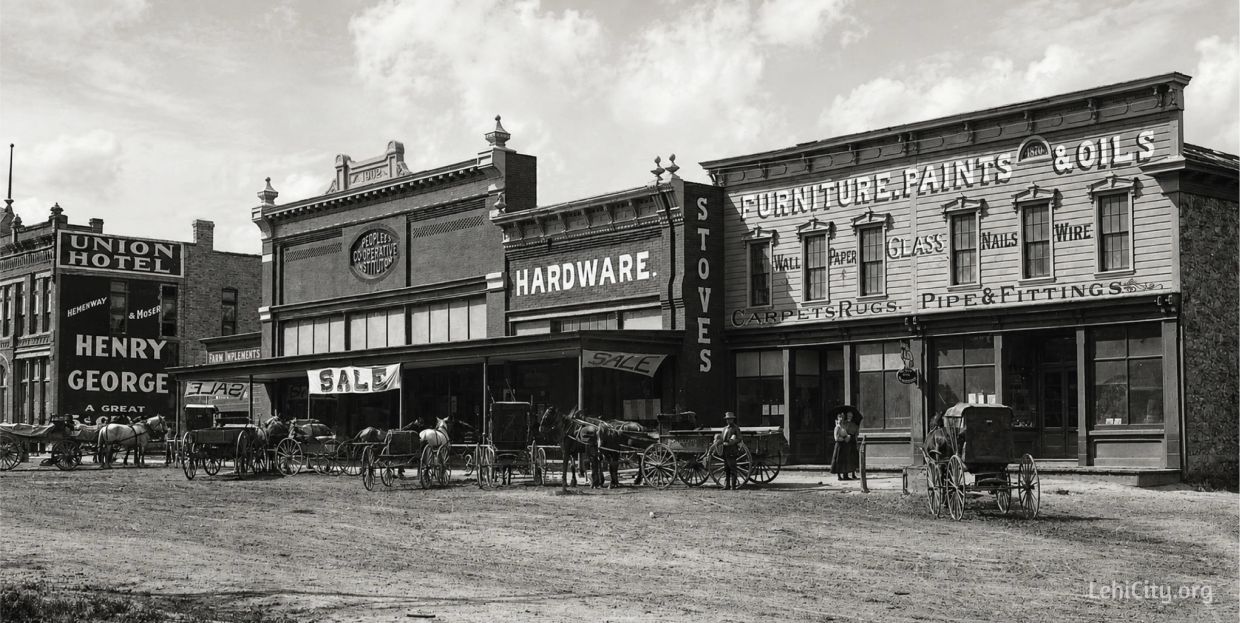
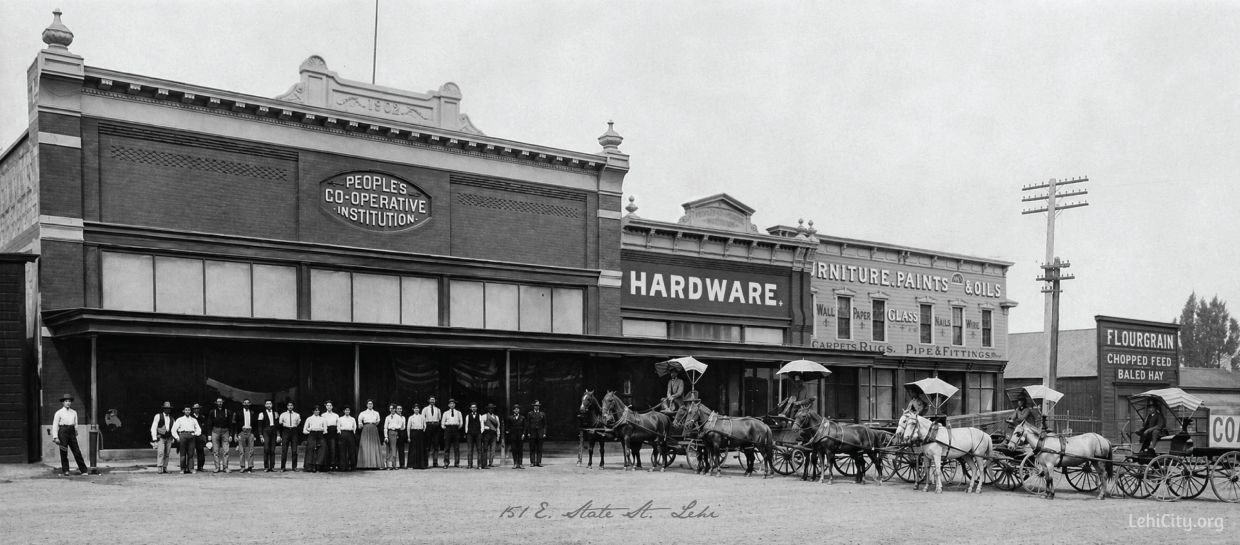
The Co-op reached another level in 1902–03, when it constructed an enormous new building at 151 East State Street. With approximately 22,000 square feet of mercantile and warehouse space, it was an impressive building for a community the size of Lehi. It was also surprisingly modern. It was among the first Lehi stores wired for electricity, and the complex became associated with other modern conveniences, including telephone service and a pneumatic tube system.
Electric lighting was still enough of a novelty that the Lehi Banner pointed out in 1903 that the new store had “no dark corners.” Even the sidewalk attracted attention. The Co-op installed what is recorded as Lehi's first cement sidewalk, and the local newspaper hoped other merchants would follow its example and help make Lehi appear more like a modern city. Something as ordinary to us today as walking on a concrete sidewalk was once a sign that Lehi was moving into a new century.
Inside, the Co-op was something like an early department store. By 1929 its departments included groceries, a butcher shop, hardware, furniture, fabrics, shoes, hosiery, hats, shirts, and ready-to-wear clothing. Earlier operations also dealt in agricultural equipment, wagons and feed. For a Lehi family, it was possible to come to the Co-op for food, clothing, household goods and supplies for the farm—all in the same business.
An Entire Block of Business
At its height, the People's Co-op was not simply one storefront. In 1912, the company purchased nearly an entire block immediately west of its large State Street store, including the Union Hotel, Peter Larsen's butcher shop and the Wines cottages. The Co-op had become one of the dominant businesses in Lehi.
The photographs from this era help bring that world back to life. Horses and wagons stand along an unpaved State Street, employees and townspeople gather in front of the stores, and large signs advertise hardware, furniture, paints, oils, flour, grain and feed. These weren't just businesses in the background of Lehi life—they were gathering places where neighbors met, news traveled, farmers conducted business and generations of Lehi families bought the things they needed for everyday life.
The Automobile Changes the Co-op's Fortune
Ironically, one of the great symbols of progress eventually worked against the Co-op.
In 1916, a gasoline pump and two 600-gallon gasoline tanks were installed in front of the store—a sign that the automobile age had arrived in Lehi. But automobiles also gave local residents something they had never had before: the freedom to easily drive to other communities to shop. Competition increased, and by the mid-1920s the People's Co-op was beginning to struggle. Between 1926 and 1936 alone, the business went through at least six different managers.
Then came the Great Depression. Economic problems affected ZCMI, the Co-op's parent organization, and in 1937 the company announced that it would abandon twenty retail branches, including the Lehi operation. After more than six decades of helping shape Lehi's commercial life, the era of the People's Co-op was coming to an end. Its large collection of Lehi properties was eventually sold off piece by piece.
From Shopping to Roller Skating
But the story of the great State Street building didn't end when the Co-op closed.
In 1939, the enormous former mercantile was transformed into a roller-skating rink called “The Niagara.” A new hardwood skating floor was installed, and its wonderfully playful advertising invited residents to “Come to the Niagara and watch the falls.” By 1940 it was operating as the Lehi Roller Skating Rink under the Smuin brothers. Imagine the change: a building once filled with groceries, hardware, furniture and farm supplies was now filled with music and generations of young people circling a skating floor.
The building continued reinventing itself. In 1948 it became Grass Furniture, which advertised with another memorable slogan: “Oh, Go to Grass.” It later housed a war-surplus business, returned briefly to roller skating, and eventually became a wholesale warehouse. The historic structure at 151 East State survived while much of the world around it changed.
More Than an Old Store
Today, when we look at these photographs, it is easy to focus on the horses, wagons, clothing and dirt streets. But the People's Co-op represents something much larger. It witnessed the arrival of the railroad, the transition from horses to automobiles, the introduction of electric lighting and concrete sidewalks, the growth of modern retailing, the hardships of the Great Depression and the transformation of Lehi throughout the late 19th and early 20th centuries.
For generations of Lehi residents, this wasn't a historic building—it was simply where they went to buy groceries, find a new pair of shoes, purchase hardware, pick up farm supplies, meet a neighbor or conduct business.

Now and Then
